Peak season exposes every weakness in your warehouse operations. Q1 is when high-performing teams quietly fix them.
The good news: you don’t need a new building, a new warehouse management system, or a massive CapEx project to reclaim warehouse capacity. Most mid-sized and enterprise operations can unlock significant improvements in warehouse efficiency with focused, low-effort optimization efforts inside their existing facility.
Smart warehouse optimization improves operational efficiency, reduces operating costs, protects cash flow, and improves customer satisfaction by enabling faster, more accurate order fulfillment. The key is optimizing your current warehouse setup, your warehouse layout, storage systems, warehouse processes, and available space, before expanding your warehouse footprint.
Below are 9 practical, low-lift ways to optimize storage space, improve space utilization, and increase storage capacity using the warehouse space and headcount you already have.

Assess Your Current Warehouse Setup First
Before you optimize your warehouse, you need clarity.
Start by reviewing your current warehouse setup, including:
- Warehouse layout and storage locations
- Storage systems, pallet racks, and pallet positions
- Material handling equipment and retrieval systems
- Inventory management workflows and picking process
Look for:
- Underutilized vertical space
- Low storage density in frequently accessed areas
- Bottlenecks caused by manual processes
- Available storage space blocked by returns, QC, or staging
This assessment helps identify where space utilization is low, labor costs are creeping up, and warehouse operations are quietly driving higher total cost. Optimizing your existing building first delivers faster cost savings than any expansion.
1. Re-Slot Your Top 50 SKUs Based on Historical Data
If you only do one warehouse optimization task, do this.
Use peak season historical data to identify:
- Top 50 SKUs by picks (not revenue)
- Current storage locations and storage systems
Then ask:
- Are frequently accessed items close to pack stations?
- Are they stored at ergonomic heights in pick-friendly pallet positions?
- Are pickers traveling excessive square footage for high-velocity inventory?
Low-effort fixes:
- Create a fast-pick zone near pack
- Use shelving or carton flow instead of deep pallet racks
- Reduce the number of storage locations per SKU
This simple re-slot aligns inventory movement with demand forecasting—unlocking warehouse capacity without touching your warehouse management system.
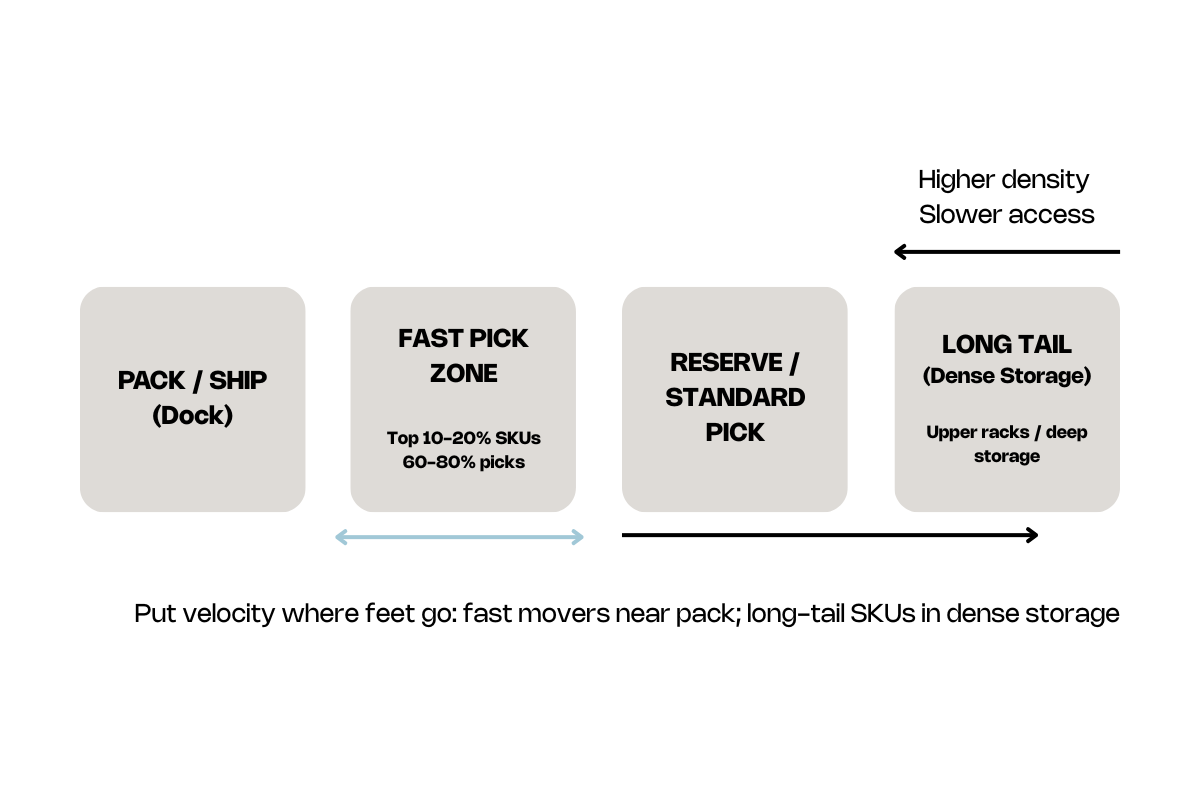
2. Separate Fast Movers From Long-Tail Inventory
An unoptimized warehouse treats all SKUs equally. That’s a mistake.
Split inventory into:
- Fast movers (top 10–20% driving most order fulfillment)
- Long-tail inventory (slow movers, seasonal, low velocity)
Then redesign your warehouse layout:
- Fast movers → accessible, low-travel zones
- Long-tail → higher pallet racks, deeper storage, upper vertical space
By utilizing vertical space and increasing storage density for slow movers, you improve warehouse space efficiency and free more space for high-velocity inventory, without expanding your warehouse footprint.
3. Standardize Cartonization for Common Order Types
Inconsistent packing destroys storage efficiency and increases operating costs.
Use historical data analytics to identify common order patterns, then standardize:
- Carton sizes
- Dunnage types
- Packing workflows
Benefits include:
- Faster packing → lower labor costs
- Better cube utilization → reduced shipping costs
- More accurate rate shopping → cost savings
- Cleaner data for warehouse performance metrics
This optimization reduces manual processes while improving operational efficiency across warehouse operations and logistics operations.
4. Clean and Consolidate Forward Pick Locations
Peak season leaves forward pick zones cluttered and inefficient.
Q1 is the moment to reset warehouse space.
Focus on:
- Consolidating partial pallets
- Removing discontinued or inactive SKUs
- Fixing mislabeled or unclear storage locations
Set simple warehouse management rules:
- No half-empty pallet positions for top SKUs
- No dead inventory in prime warehouse space
This improves space utilization, reduces mis-picks, and increases available storage space where it matters most.
5. Introduce Basic Batch or Cluster Picking
You don’t need advanced warehouse automation to improve the picking process.
Start with simple batching:
- Batch single-line orders
- Bulk-pick frequently paired SKUs
- Use multi-tote carts or simple pick-to-pack flows
Results:
- More lines picked per hour
- Lower travel distance
- Reduced labor per order
Even modest batching reduces dependence on manual processes and sets the foundation for future warehouse automation.
6. Redesign Pack Stations Around Motion Efficiency
Pack stations often grow inefficient over time.
Conduct a basic motion study with warehouse staff:
- Count unnecessary steps and reaches
- Identify trips for supplies
- Track wasted movement
Then redesign for:
- Consistent layouts
- Single-reach access to high-use items
- Pre-staged supplies per shift
This improves warehouse efficiency, reduces fatigue, lowers labor costs, and improves customer service by speeding up order fulfillment.
7. Control the Staging Area Before It Eats Your Space
Staging areas silently destroy available space.
Fix it by:
- Defining carrier-specific staging lanes
- Aligning staging layout with dock schedules
- Setting time limits for dwell
Well-managed staging improves warehouse performance, throughput, and shipping accuracy, without increasing square foot usage.
8. Streamline Returns and QC Flow
Returns and QC often block prime warehouse space.
Create clear rules:
- SLA targets for returns processing
- Defined paths for resellable, damaged, and unsellable inventory
- Dedicated areas outside primary storage space
Cleaning up returns flow increases storage capacity, improves inventory levels visibility, and prevents “ghost inventory” from inflating operational costs.
9. Track Daily Warehouse Performance Metrics
You can’t optimize what you don’t measure.
Start with a simple warehouse performance metrics board:
- Lines picked per labor hour
- Orders packed per station
- Same-day ship rate
- Rework and mis-pick counts
- Staging dwell time
These key metrics provide valuable insights, help reduce costs, and create a feedback loop that drives continuous improvement, without a large initial investment in software solutions.
Emerging Trends in Low-Lift Warehouse Optimization
Modern warehouse management is increasingly supported by:
- Data analytics and predictive analytics
- Automated storage and retrieval systems
- Pick-to-light systems
- Labor management systems
- Mezzanine floors to increase storage capacity
- Automated guided vehicles for targeted workflows
These technologies help optimize storage space, reduce operating costs, and improve warehouse performance, but the biggest wins still come from optimizing your existing space first.
Small Tweaks, Big Warehouse Capacity Gains
None of these nine changes require a new warehouse management solution, new building, or massive automation rollout. Yet together, they deliver:
- Increased warehouse capacity in your existing building
- Improved space utilization and storage efficiency
- Lower labor and operating costs
- Faster order fulfillment and improved customer satisfaction
- A competitive advantage heading into the next peak season
That’s the core of smart warehouse optimization: using Q1 to remove friction, not just add headcount.
Peak season will always be intense. The question is whether your optimization efforts make it productive, or painful in exactly the same ways next year.
Related Topics
Learn how VESYL can save you money on shipping
Not sure which plan suits you best? Have questions about our software? Contact our sales team for expert guidance.
%20(1).webp)
.webp)
%20(1).webp)
.webp)