.png)
For most ecommerce businesses, January feels like a hangover: outbound volume drops, shipping returns spike, teams are fatigued, and warehouses fill with unprocessed returned goods.
Operations leaders often experience this as a pure cost problem, shipping labels, labor, write-offs, inventory distortion, and losses related to returns. But brands that win long term treat January differently.
They use shipping returns as signal.
With an optimized reverse logistics process, returns become a measurable, controllable lever for customer loyalty, margin protection, and supply chain optimization, not just an expense line impacting gross income or reported income.
Leading brands focus on increasing efficiency across the reverse supply chain, using automation, data analytics, and integrated systems to transform returns management into a strategic advantage.
This guide breaks down how operations leaders can:
- Use January shipping returns data to identify product, fulfillment, and delivery failure issues
- Design a reverse logistics process that is predictable, scalable, and retention-focused
- Operationalize returns in the warehouse so they stop clogging inventory management and start driving better decisions
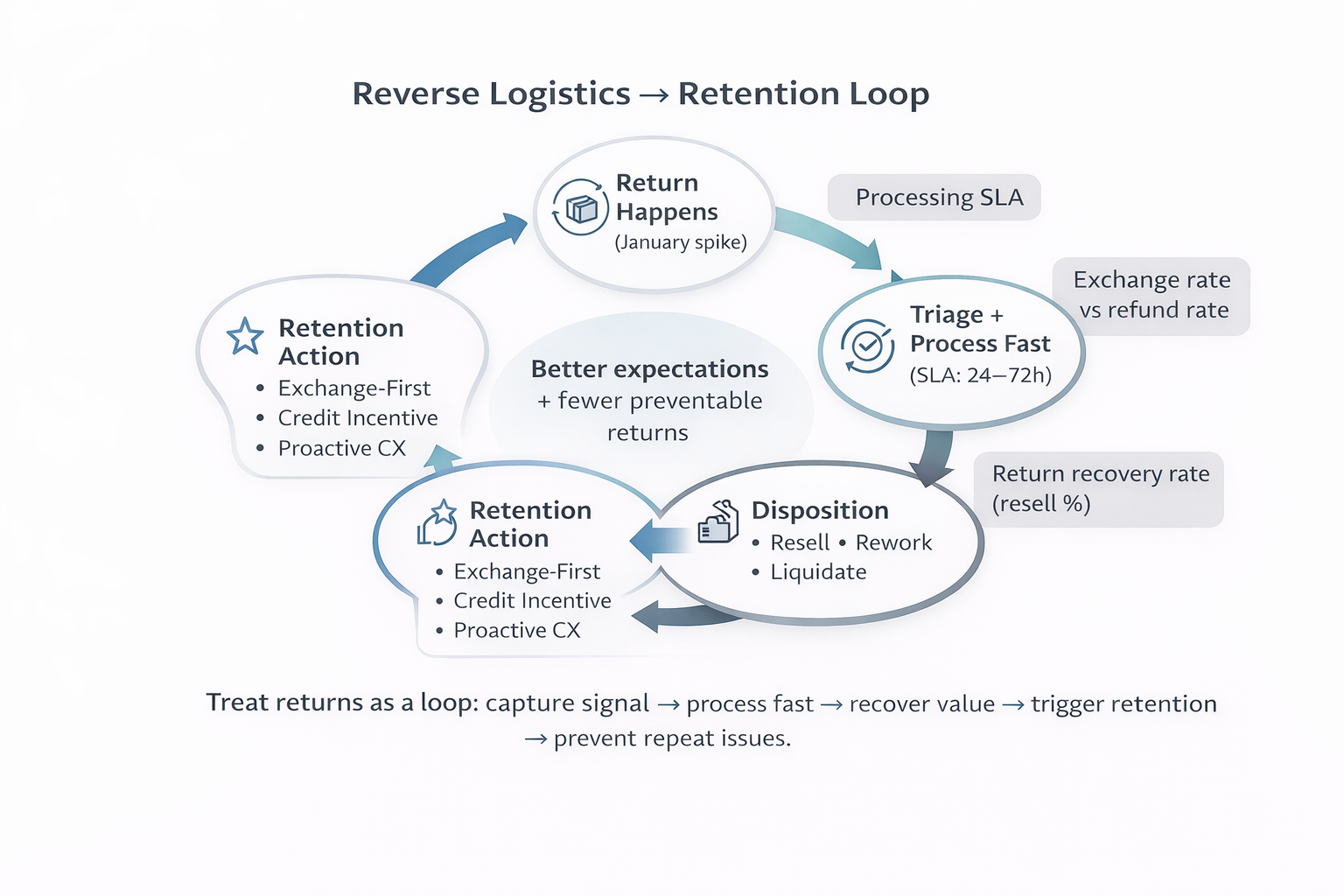
What Is Reverse Logistics and Why Does It Matter in Shipping Returns?
Reverse logistics refers to the process of moving returned items from the end user back through the supply chain to the retailer or manufacturer.
Unlike forward shipping, where the goal is speed to delivery, the reverse logistics process manages:
- Shipping returns and delivery refusals
- Warranty work and repair department flows
- Recycling, resale, donation, or disposal of returned items
- Surplus goods across the product life cycle
In modern ecommerce, a solid reverse logistics plan is no longer optional. Reverse logistics is now a permanent fixture of supply chain management, especially as online shoppers expect easy returns, extended windows, and transparent tracking.
When poorly managed, reverse logistics can:
- Drive up supply chain costs
- Create unnecessary waste
- Damage customer loyalty
- Reduce inventory visibility and efficiency
When optimized, reverse logistics improves customer satisfaction, reduces operational costs, and provides another critical opportunity for supply chain optimization.
1. January Shipping Returns Are a Retention Moment, Not Just a Cost Center
January concentrates three high-value signals operations leaders cannot afford to ignore:
First-time holiday buyers
Many customers experience your brand for the first time through a return process, not a purchase.
Product and fit issues at scale
High return rates expose expectation gaps that marketing alone cannot fix.
Shipping and fulfillment failures
Late deliveries, delivery failure, damaged packages, mis-picks, poor packaging materials, or transportation issues.
Across the industry, January consistently produces high return rates, but treating returns purely as a cost center misses critical opportunities to:
- Save relationships with high-LTV customers
- Identify operational failures across the supply chain
- Redesign returns management instead of tightening policies blindly
Operations owns this lever because reverse logistics strategy is fundamentally about process, network design, and execution.
2. Build a Shipping Returns Data View That’s Actually Useful
Before implementing strategies or rewriting policies, operations teams need a clean, structured view of the return process.
At minimum, capture:
Order & Customer Records
- Order ID, order date, delivery date
- Customer account (new vs repeat)
- Channel (DTC, marketplace, wholesale)
- AOV, items per order
Returns Management Data
- Return initiation date (days from delivery → original return)
- Return category (SKU, size, color, quantity)
- Return reason (defective products, changed mind, delivery failure, poor sales expectations)
- Outcome (refund, exchange, credit, rejected)
Shipping & Fulfillment Data
- Carrier and service level
- Time-in-transit vs promise
- Exceptions (damage, delay, delivery refusal)
This enables ops teams to identify:
- Which categories drive the most shipping returns
- Where product returns differ from shipping-driven failures
- How behaviors differ between new customers and repeat buyers
3. Separate Product Returns From Shipping Returns
One of the biggest mistakes in reverse logistics management is treating all returns as the same.
3.1 Product Returns
Patterns often include:
- Fit or sizing issues
- Quality complaints or defective products
- Warranty work or repair department needs
- Expectation gaps driven by marketing or packaging
These require collaboration with product, merchandising, and CX teams.
3.2 Shipping Returns
These are operational failures:
- Late delivery driving refunds
- Carrier-specific damage trends
- Wrong item errors tied to pick paths
- Label or package handling issues
Shipping returns are diagnostics for where the reverse supply chain is actively creating churn.
Operations should track return rates by:
- Carrier and zone
- DC or fulfillment node
- Time-in-transit vs promise
4. Design a Returns Policy Focused on Customer Loyalty
A customer-centric returns policy directly impacts customer satisfaction and retention.
Key policy levers include:
- Free returns for strategic cohorts
- Store credit vs refund incentives
- Return window length (many retailers extended holiday returns until January 31, 2026)
- Restocking fees for opened electronics or furniture
Generous policies reduce friction for high-value customers, while data helps identify fraudulent returns and abuse once limitations expire.

5. Operationalize Shipping Returns in the Warehouse
Policy fails if warehouse execution breaks.
January returns can quietly destroy capacity if not structured.
5.1 Returns Triage by Category
Every returned item should be classified quickly:
- Resellable as new
- Resellable with rework
- Non-resellable (donation, recycling, disposal)
Clear SLAs, defined physical zones, and ownership reduce unnecessary waste and speed inventory recovery.
5.2 Systems, Labels, and QR Codes Matter
Modern reverse logistics depends on clean systems:
- Return label and shipping label accuracy
- QR code–based check-in for no-print returns
- Real-time inventory updates
- Aging visibility for returned goods
For example, customers can create a return shipping label on FedEx online or at a retail location. FedEx supports over 56,000 drop-off points, including QR code no-label returns, allowing customers to return packages without printing a label.
Customers can also track returned items in real time, improving transparency and trust.
6. Turn Shipping Returns Into a Retention Lever
Returns retention is what happens after the return.
6.1 Close the Loop With CX and Marketing
Link every return to the customer account to enable:
- Proactive communication after delivery failure
- Faster refunds (often processed within 5–10 business days)
- Exchange-first offers when fit issues occur
Measure:
- Repeat purchase rate post-return
- Lifetime value of customers with optimized returns experiences
- Impact of faster refunds on customer loyalty
7. Make Reverse Logistics a Standing Ops Strategy
Leading businesses treat reverse logistics as ongoing, not seasonal.
January
- Deep review of shipping returns, by category, carrier, and customer cohort
Quarterly
- Review SLAs, costs, inventory impact, and retention metrics
- Feed insights into supply chain management, product, and CX
An optimized reverse logistics strategy turns January into a dashboard, not a disaster.
Measuring Success: Reverse Logistics KPIs That Matter
Track metrics that connect returns to business outcomes:
- Return rates by category and carrier
- Processing time from receipt to disposition
- Inventory recovery speed
- Customer repeat purchase rate
- Net margin after returns and incentives
Data analytics plays a critical role in identifying trends, reducing costs, and improving inventory management across the reverse supply chain.
Related Topics
Learn how VESYL can save you money on shipping
Not sure which plan suits you best? Have questions about our software? Contact our sales team for expert guidance.
%20(1).webp)
.webp)
%20(1).webp)
.webp)