

Choosing the right multi-carrier shipping software is one of the most important operational decisions an ecommerce business can make. Get it right and you lower shipping costs, improve delivery times, and scale without adding headcount. Get it wrong and you spend months working around a platform that was never built for your volume or complexity.
The complexity of shipping logistics increases significantly with larger order volumes and the need to integrate data from multiple carriers. What works at two hundred monthly orders breaks down at twenty thousand. And most platforms are better at hiding that gap in their marketing than they are at closing it in practice.
This article gives you a direct, honest comparison of the leading multi-carrier shipping software options available to ecommerce brands in 2026, what each does well, where each falls short, and how to evaluate them against what your operation actually needs.
What Is Multi-Carrier Shipping Software and Why Does It Matter?
Multi-carrier shipping software connects your online store to multiple shipping carriers, consolidating rate shopping, label generation, tracking, and carrier performance analytics into one platform. Instead of logging into individual carrier websites to compare rates and print labels manually, everything happens in a single interface.
For scaling ecommerce businesses, multi-carrier shipping is not optional. No single carrier is the cheapest or fastest across every lane, zone, and package type. Real-time rate shopping allows you to find the most cost-effective option from carriers including USPS, FedEx, DHL, and UPS on every shipment, automatically, without manual comparison. The ability to route each order to the right carrier at the right rate is where the cost savings compound into something material over time.
Multi-carrier shipping also protects your operations from disruption. Diversifying across shipping carriers protects ecommerce businesses from strikes, regional weather delays, and capacity constraints that affect any single carrier. When one carrier has a problem, volume can be rerouted rather than delayed.
The difference between platforms lies in how deeply they support that decision-making at scale, not just whether they connect to multiple carriers.
What to Look for in Multi-Carrier Carrier Shipping Software
Before comparing platforms, understanding which capabilities separate genuinely useful multi-carrier shipping software from tools that simply aggregate carrier accounts is the foundation of a good evaluation.
Key Features That Drive Real Operational Value
Real-time rate comparison across multiple carriers at the point of label generation is the foundation. Users can often save up to 20% by using automated rate shopping to select the most cost-effective carrier options. Without it, you are not doing multi-carrier shipping. You are doing multi-carrier account management, which is slower and more error-prone than a single-carrier setup.
Automation rules that encode your shipping logic into the platform are what make multi-carrier shipping scalable. Automated batch printing and custom shipping rules can significantly reduce manual labour in the shipping process. The ability to set rules that automatically select the cheapest carrier for a given zone, the fastest carrier for a time-sensitive shipment, or the right regional carrier for a specific delivery area removes manual decision-making from every label at every volume.
Integration depth matters more than carrier count. A platform that lists hundreds of carrier integrations but only supports real-time rate shopping on a fraction of them is less useful than a platform with fewer carriers and deeper integrations on the lanes you actually use. High-quality shipping software integrates not just with carriers but with marketplaces like Shopify, WooCommerce, and Amazon, as well as ERP and warehouse management systems, so order data flows automatically without manual re-entry.
Carrier performance analytics give you the data to hold carriers accountable to their service level agreements, identify underperforming lanes, and make carrier selection decisions based on historical delivery performance rather than assumptions. Most platforms surface tracking events. Fewer connect those events to the performance trends that inform strategic decisions.
Branded tracking pages improve the post-purchase customer experience by providing real-time updates and reducing inbound inquiries about order status. Every customer who places an order will check their tracking. What they see during that experience shapes their perception of your brand as much as the product itself.
Returns management capability is increasingly a baseline requirement. Effective returns management directly impacts customer satisfaction and retention rates. Returns management software that includes automated return label generation, return shipment tracking, and integration with inventory management systems reduces the operational cost of returns while maintaining a positive customer experience.
Best Multi-Carrier Shipping Software for Ecommerce Brands: Platform Comparison
VESYL
Best for: high-volume ecommerce businesses that need industry-leading rate shopping, powerful shipping automations, and operational support from a team with deep warehouse expertise.
Most shipping software is built by people who understand software. VESYL is built by people who understand warehouses.
The team behind VESYL brings over 70 years of combined warehouse experience, boots on the ground across fulfillment operations of different sizes, industries, and complexity levels. They have seen firsthand where shipping operations crack under volume, where bottlenecks form, and where decisions that look fine on a dashboard are quietly costing money on the warehouse floor. That operational depth is built into every detail of the platform in a way that software-first tools cannot replicate.
The VESYL Rate Shop sits at the core of the platform. It is the only rate shopping engine of its kind on the market, saving ecommerce businesses up to 90% on shipping costs by evaluating every shipment against real-time carrier rates and the ability to automatically rate shop, selecting the most cost-effective option that meets the delivery requirement, on every order.
The automations layer is where operators running complex fulfillment will feel the difference most. Carrier selection, packaging decisions, insurance application, and rate preferences are all configurable based on order characteristics, product type, destination, and volume. These are not surface-level rules. They are built to handle the kind of operational complexity that comes from running real warehouses at real scale, because the people who designed them have lived that complexity themselves.
Batch shipping removes the bottleneck that sequential label generation creates, processing high volumes simultaneously, reducing time and manual errors.
Support reflects the same philosophy. Ecommerce businesses get access to real people who understand shipping operations at a granular level, not a ticket queue. When something goes wrong at high volume, the resolution path is someone who has likely seen that exact problem before in a warehouse, not someone reading from a script.
Pricing is transparent and built to scale, with no hidden per-label fees and custom pricing available for high volume shippers through a direct conversation.
VESYL is built for ecommerce businesses that have outgrown basic label printing tools and want a platform where every feature reflects what it actually takes to run shipping operations at scale, designed by people who have done exactly that.
.png)
ShipStation
Best for: mid-market ecommerce brands with multiple sales channels who need reliable multi-carrier automation across a wide range of platform integrations.
ShipStation is one of the most widely adopted multi-carrier shipping platforms in the ecommerce market. It supports a large number of integrations with ecommerce platforms, marketplaces, and carrier accounts, and offers automation rules that handle routing logic based on weight, destination, and service level.
For ecommerce businesses with straightforward multi-carrier needs and high order volumes across multiple sales channels, ShipStation covers the basics well. The user interface is clean and the platform integrates with most major ecommerce platforms without significant setup complexity.
Monthly fees scale with shipment volume, which creates cost predictability but can become expensive at scale relative to platforms with flat or custom pricing structures. Where ShipStation is weaker is in carrier performance analytics depth and support quality at high volume. The platform excels at automating established shipping workflows but gives less visibility into the carrier performance trends that inform strategic decisions. Support is primarily self-service and ticket-based, which creates friction when operational issues need fast resolution.
Shippo
Best for: small businesses and early-stage ecommerce brands at low shipment volume who need basic multi-carrier rate comparison without significant upfront cost.
Shippo offers a pay-as-you-go free tier with per-label fees and a paid plan at a low monthly subscription, making it accessible for brands at low shipment volume who want multi-carrier rate comparison without significant commitment.
The platform integrates with Shopify, WooCommerce, BigCommerce, and other major ecommerce platforms, and supports real-time rate comparison across its carrier network. Automated label creation and basic shipping rules are available on paid plans.
Shippo's limitations become apparent at higher volumes. Carrier coverage and automation features are less comprehensive than platforms built for scale, and carrier performance analytics are limited. The per-label fee model on the free tier also becomes expensive relative to subscription-based alternatives once shipment volume reaches a meaningful level. Many ecommerce shipping software platforms negotiate discounted rates with carriers that individual shippers cannot access independently, and the depth of those negotiated rates varies significantly across platforms at scale.
Easyship
Best for: ecommerce businesses with substantial international shipping volume who need automated customs documentation and broad global carrier coverage.
Easyship is purpose-built for international shipping, connecting merchants with over 550 courier services worldwide and automating customs documentation, tax calculations, and duty management for cross-border shipments. Automated customs handling can save ecommerce businesses hours of paperwork and streamline the international shipping process in ways that manual customs form completion cannot at any meaningful volume.
The platform provides real-time rate comparison across international carriers, automated customs documentation, and multi-language tracking that keeps international customers informed in their own language. International shipping often involves navigating complex customs regulations and duties that vary significantly by country and product type. Easyship addresses that complexity with automation rather than leaving it as a manual step.
Where Easyship is weaker is in domestic carrier performance analytics and the depth of automation rules for complex domestic routing logic. It is optimised for international shipping breadth rather than domestic shipping operational depth.
Sendcloud
Best for: European ecommerce businesses and merchants with significant EU shipping volume who need deep regional carrier integration and automated cross-border compliance.
Sendcloud connects over 160 carriers with strong EU carrier coverage, automates customs documentation for cross-border shipments within and beyond the EU, and supports multi-language tracking pages for European customers.
For ecommerce businesses with a European customer base, Sendcloud's carrier connectivity across regional European carriers is a meaningful advantage over US-first platforms that support European shipping at surface level. Sendcloud's limitations are primarily geographic. For ecommerce businesses whose shipping operations are primarily domestic US or Asia-Pacific, Sendcloud's carrier coverage and feature set are not optimised for those markets.
Veeqo
Best for: Amazon and Shopify sellers who need free multi-carrier label printing without advanced automation or carrier performance requirements.
Veeqo is a free multi-carrier shipping platform particularly suited to sellers on Amazon and Shopify who need basic multi-carrier label printing and order tracking without a subscription fee or monthly fees. It offers unlimited users and shipments on its free tier, making it accessible for ecommerce businesses at any volume on a tight shipping budget.
The platform covers the fundamentals: import orders from connected ecommerce platforms, compare carrier rates, print labels, and track shipments. Where Veeqo falls short is in carrier performance analytics, advanced automation rules, and the operational depth needed by logistics teams managing complex shipping operations. The free tier model also raises questions about long-term strategic direction given its ownership structure, which is relevant for ecommerce businesses evaluating carrier shipping software for the long term.
Multi-Carrier Shipping: How to Choose the Right Platform for Your Operation
The right multi-carrier shipping software depends on four variables: your shipment volume, the complexity of your carrier mix, your international shipping requirements, and the level of operational intelligence you need from the platform.
Matching Platform to Shipment Volume
At low shipment volume, the priority is access to discounted rates and basic rate comparison across multiple shipping carriers. Platforms with a free plan or low monthly fees are appropriate at this stage. The operational sophistication of the platform matters less than cost and ease of use.
At high volume, the priority shifts entirely. Carrier performance analytics, deep automation rules, real-time rate shopping across regional and national carriers, and a support model that resolves issues fast become the critical factors. Automation and batch processing can dramatically speed up fulfillment times at scale, but only if the platform is built to support that throughput reliably. The cheapest entry point on a free tier is rarely the most cost-effective platform at high shipment volume when you factor in the operational overhead of working around its limitations.
Carrier Integration Depth for High Volume Shippers
High volume shippers need carrier integration that goes beyond connecting carrier accounts and printing labels. The complexity of shipping logistics increases with larger order volumes and the need to integrate data from multiple carriers, making platform depth a genuine operational requirement rather than a nice-to-have. Real-time rate comparison that includes regional carriers alongside major national carriers gives your routing logic more options and consistently lower shipping costs across your order mix.
Carrier Performance Analytics for Logistics Teams
Logistics teams managing complex shipping operations need more than tracking events and delivery confirmation. Carrier performance analytics that surface on-time delivery rates by carrier, lane, and service level give you the data to make strategic carrier decisions, hold carriers accountable to their service level agreements, and identify underperforming lanes before they become patterns of customer dissatisfaction. Most platforms provide basic tracking. Fewer provide the analytics that connect delivery data to operational action.
International Shipping Requirements
For ecommerce businesses with meaningful international volume, the key features are automated customs documentation, real-time rate comparison across international carriers, and reliable global coverage. The choice of shipping carrier greatly impacts the efficiency and cost of international shipping, as different carriers have varying capabilities and coverage for global deliveries. Not all multi-carrier platforms handle this equally, and the gap between a platform built for international shipping and one that supports it as an afterthought is significant in practice.
Ecommerce Platforms and Carrier Connectivity: What Connects Your Stack
Multi-carrier shipping software sits within a broader operational stack that includes your ecommerce platform, order management system, and warehouse management system. Integrating order management systems with ecommerce platforms streamlines the shipping process, enabling businesses to manage orders from a single dashboard and improve overall operational efficiency. The quality of those integrations determines how much manual work remains in your shipping process after adoption.
Clean carrier connectivity means order data flows automatically into label generation, tracking information flows back to the customer without manual updates, and shipping data flows into your performance reporting without manual exports. Every gap in that integration chain is a manual step that adds labour cost and introduces error risk into the entire shipping process.
When evaluating platforms, test the integration with your specific ecommerce platforms and operational stack before committing. A platform that works cleanly with Shopify may not work as cleanly with a custom order management system or warehouse management system your operation depends on.
.png)
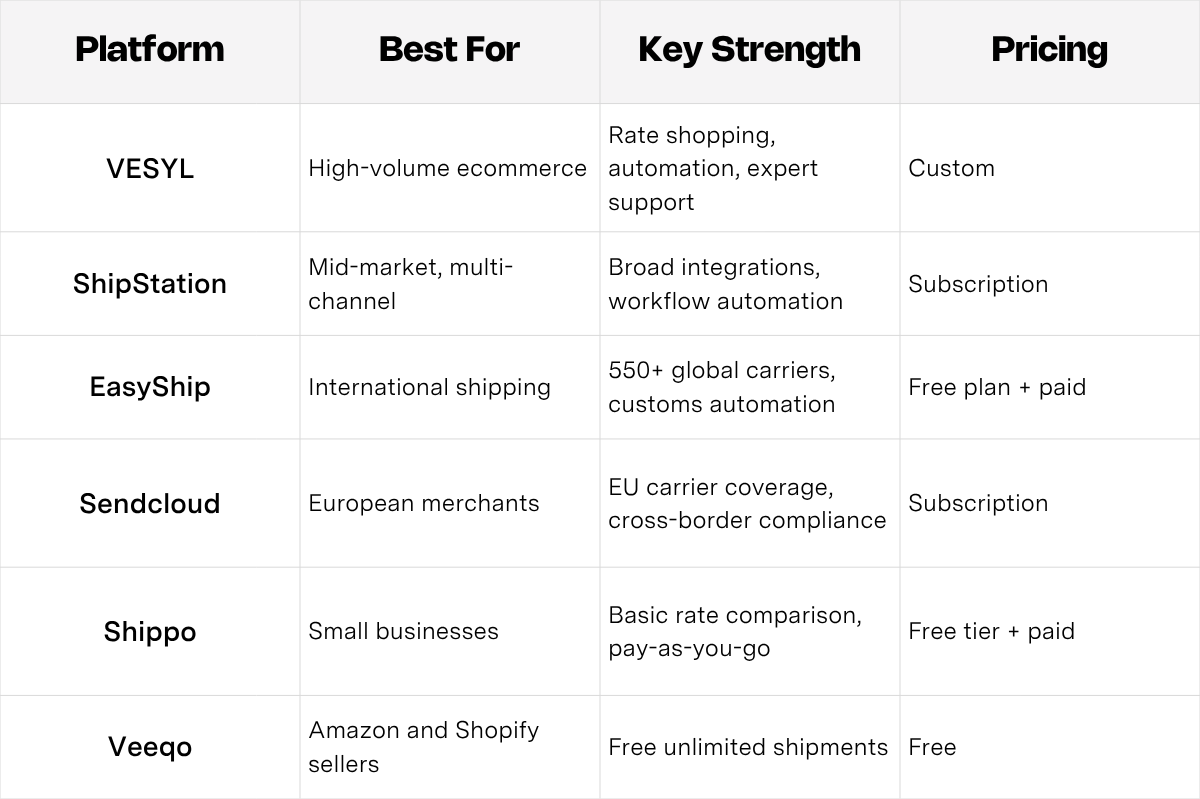
Key Features Summary: How the Platforms Compare
For small businesses and early-stage ecommerce brands at low shipment volume who need basic multi-carrier rate comparison without a subscription fee, Shippo and Veeqo cover the fundamentals at low or no cost.
For mid-market ecommerce businesses with multiple sales channels and established shipping workflows who need reliable multi-carrier automation, ShipStation is a mature, widely integrated option.
For ecommerce businesses with significant international shipping volume who need automated customs documentation and global carrier coverage, Easyship handles international complexity that domestic-first platforms do not.
For European ecommerce businesses and merchants with EU carrier requirements, Sendcloud provides regional carrier connectivity and cross-border compliance that US-first platforms cannot match.
For ecommerce businesses at meaningful volume who need the most powerful rate shopping engine on the market, deep automation built by people who have run real warehouse operations, and a support model that puts real expertise behind every interaction, VESYL is built for that.
Your Operation Deserves Better Than a Ticket QueueTalk to a real shipping expert, someone who has been on the warehouse floor and knows exactly where operations like yours crack under volume. No scripts. No generic demos. Just a straight conversation about what VESYL can do for you.
Related Topics
Learn how VESYL can save you money on shipping
Not sure which plan suits you best? Have questions about our software? Contact our sales team for expert guidance.
%20(1).webp)
.webp)
%20(1).webp)
.webp)